








Accessibility Exposure Read - what a claim letter would reach first
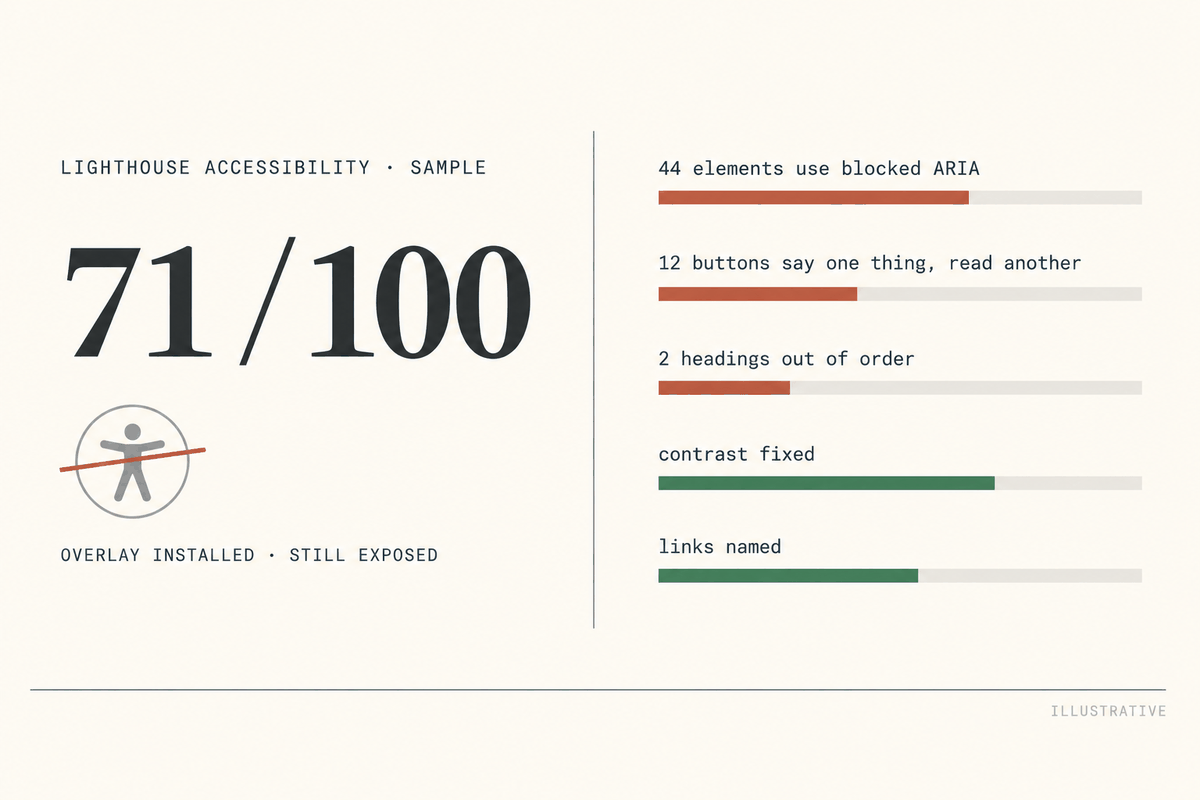
Description
You end up knowing where your store is exposed and what it takes to close it, in priority order. The read fee is held as a deposit toward the fixes, not a charge on top of it.
Who this is for
You might be saying one of these.
"A lawyer sent a letter about my website, and I don't know what it means."
"Someone told me my shop breaks the rules for disabled shoppers."
"I added an accessibility widget. Am I covered?"
"I sell into Europe, and I heard the rules changed."
If any of those sound like you, this read tells you where you stand and what to do first.
What it fixes
Some shoppers cannot use a mouse. They move through a page with the keyboard instead. Others cannot see the screen. They use a screen reader, which reads the page out loud. When a menu will not open with keys, that shopper is stuck. When a button has no name the reader can say, that shopper cannot buy. They leave, and the sale goes with them. These gaps on the way to buying are also what complaint letters point at first.
Many stores add a widget to handle this. A widget sits on top of the page. It does not change what is underneath, so the problems stay where they were.
What you get
I test your shop the way these shoppers use it. I use the keyboard and a screen reader, page by page, from the home page to the cart. I do not lean on a scanner score. Scanners miss real problems and flag ones that are not there. I also check whether a widget is covering problems it does not fix.
You get a list ranked by what a complaint would reach first. Each item says what is wrong, who it stops, and what closes it. Then I fix them.
How it works
First, you tell me which pages bring in the most sales.
Next, I test those pages and the path from a product to the cart.
Then you get the ranked list, with a fixed price for the fixes.
When you say yes, I fix them from the top of the list down. Last, I test again the same way, so you can see each item closed.
What is outside this service
This is not legal advice, and I am not a lawyer. If a letter has already arrived, keep your lawyer in the loop. I can work alongside them and give them a clear record of what was found and what was fixed. Shopify runs its own checkout pages, so my testing goes up to the cart. A change to your brand colors across the whole site is a design decision. I can show you where color makes text hard to read, and that can be a next step.
Questions people ask
Does a widget protect me?
It does not fix the page underneath. I check what yours covers and what it leaves open.
Will this make my store fully compliant?
No one can honestly promise that. What I can promise is this. The problems a complaint reaches first get found and fixed, and you have a record of it.
I sell into the EU. Do I need this?
It depends on your size. Firms below a set size can be exempt from the EU rules. If that may be you, I say so before you pay for any fixes.
What if the fixes cost more than the fee?
You pay the difference, once you agree to a fixed price. If you decide not to go ahead, you keep the full findings.
The fee credits toward the fix. Most of the stores I hold a monthly seat with started with one of these.
'%20style='mix-blend-mode:plus-lighter'%3e%3cpath%20d='M293.421%2055.9546H463.536L701.016%20775.916H55.9546L293.421%2055.9546Z'%20fill='url(%23paint0_linear_0_18)'/%3e%3c/g%3e%3cdefs%3e%3cfilter%20id='filter0_f_0_18'%20x='0'%20y='0'%20width='756.971'%20height='831.87'%20filterUnits='userSpaceOnUse'%20color-interpolation-filters='sRGB'%3e%3cfeFlood%20flood-opacity='0'%20result='BackgroundImageFix'/%3e%3cfeBlend%20mode='normal'%20in='SourceGraphic'%20in2='BackgroundImageFix'%20result='shape'/%3e%3cfeGaussianBlur%20stdDeviation='27.9773'%20result='effect1_foregroundBlur_0_18'/%3e%3c/filter%3e%3clinearGradient%20id='paint0_linear_0_18'%20x1='360.25'%20y1='55.9546'%20x2='360.25'%20y2='739.522'%20gradientUnits='userSpaceOnUse'%3e%3cstop%20stop-color='%23818DBF'/%3e%3cstop%20offset='1'%20stop-color='%23818DBF'%20stop-opacity='0'/%3e%3c/linearGradient%3e%3c/defs%3e%3c/svg%3e)
'%20style='mix-blend-mode:plus-lighter'%3e%3cpath%20d='M27.9773%2027.9773H198.092L198.119%20747.938H27.9962L27.9773%2027.9773Z'%20fill='url(%23paint0_linear_0_16)'/%3e%3c/g%3e%3cdefs%3e%3cfilter%20id='filter0_f_0_16'%20x='0'%20y='0'%20width='226.096'%20height='775.916'%20filterUnits='userSpaceOnUse'%20color-interpolation-filters='sRGB'%3e%3cfeFlood%20flood-opacity='0'%20result='BackgroundImageFix'/%3e%3cfeBlend%20mode='normal'%20in='SourceGraphic'%20in2='BackgroundImageFix'%20result='shape'/%3e%3cfeGaussianBlur%20stdDeviation='13.9887'%20result='effect1_foregroundBlur_0_16'/%3e%3c/filter%3e%3clinearGradient%20id='paint0_linear_0_16'%20x1='94.807'%20y1='27.9773'%20x2='94.807'%20y2='711.545'%20gradientUnits='userSpaceOnUse'%3e%3cstop%20stop-color='%23818DBF'/%3e%3cstop%20offset='1'%20stop-color='%23818DBF'%20stop-opacity='0'/%3e%3c/linearGradient%3e%3c/defs%3e%3c/svg%3e)
'%20style='mix-blend-mode:plus-lighter'%3e%3cpath%20d='M558.852%2083.9319H728.967L1203.93%20803.893H83.9319L558.852%2083.9319Z'%20fill='url(%23paint0_linear_0_14)'/%3e%3c/g%3e%3cdefs%3e%3cfilter%20id='filter0_f_0_14'%20x='0'%20y='0'%20width='1287.86'%20height='887.825'%20filterUnits='userSpaceOnUse'%20color-interpolation-filters='sRGB'%3e%3cfeFlood%20flood-opacity='0'%20result='BackgroundImageFix'/%3e%3cfeBlend%20mode='normal'%20in='SourceGraphic'%20in2='BackgroundImageFix'%20result='shape'/%3e%3cfeGaussianBlur%20stdDeviation='41.966'%20result='effect1_foregroundBlur_0_14'/%3e%3c/filter%3e%3clinearGradient%20id='paint0_linear_0_14'%20x1='625.681'%20y1='83.9319'%20x2='625.681'%20y2='767.499'%20gradientUnits='userSpaceOnUse'%3e%3cstop%20stop-color='%23818DBF'/%3e%3cstop%20offset='1'%20stop-color='%23818DBF'%20stop-opacity='0'/%3e%3c/linearGradient%3e%3c/defs%3e%3c/svg%3e)

- Design, UX & Branding
- Shopify Development
- Store Setup & Management
- Consulting & Strategy
- Copywriting & Content
- Marketing & Growth
- AI & Emerging Tech
- Finance, Taxes & Compliance
- Operations, Logistics & Fulfillment
- Technical Support & Maintenance
- Training, Coaching & Support
- SEO (Search Engine Optimization)
- Check All Services