







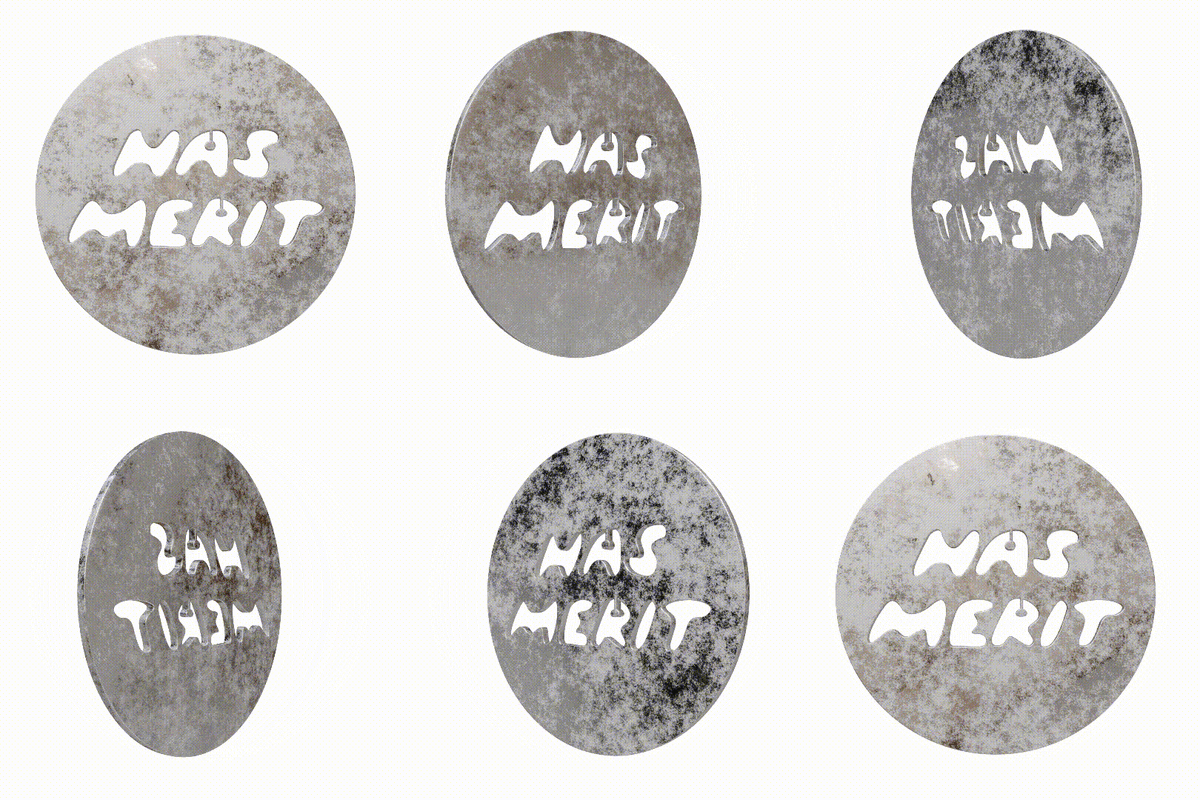
HAS MERIT is a studio crafting conversion-driven Shopify storefronts and building brands for ambitious companies. We design and develop polished sites that feel like real brands (not quick templates) and back them with brand identity systems that create lasting recognition. From strategy to branding to design to development, everything’s done in-house for a seamless process. We’re a great fit for brands seeking personalized brand design paired with thoughtful conversion strategy, without the agency fluff or freelance hit-or-miss. Building Digital Storefronts: Personalised Design - tailored layouts built to sell, not just look good. Custom Development - beyond just templates, crafted solutions for your brand. Conversion Optimisation - auditing and smarter UI/UX so you don’t leave money on the table. Brand & Identity Design - constructing a brand that stands out and connects. Seamless Integrations - payments, shipping, and tools connected without friction. We just helped an FMCG brand increase conversions by 56% and increased net sale by 86% within 30 days by tweaking their existing page. Female-founded by a designer/developer with experience across brands of all sizes, partnered with a commercial lead from top global CPGs and agencies, we blend design, strategy, and business insight to help brands stand out and scale. Our clients have been featured in Forbes, Vogue, Allure, mindbodygreen, Whole Foods and more
Shopify Logo Design and Brand Identity Designers
A logo that looks sharp on a business card can fall apart on a Shopify store. It gets squeezed into a header, shrunk to a 32-pixel browser tab icon and dropped onto dark hero images. Shopify logo design means designing for those places from the start, along with the colours, type and rules that keep everything consistent.
This service produces the visual identity: logo, colour palette, typography, icons and brand guidelines. It isn't brand strategy, the positioning and messaging work that should come first, and it isn't banners or everyday web graphics, which sit with graphic designers.
As of September 2026, 517 experts on shopexperts list logo and visual identity work. Most are full-service Shopify agencies that offer identity alongside store builds, so check each portfolio for identity projects rather than relying on the tag. Compare them below or request a quote for your identity project.


How to choose a brand identity designer
Look for identity projects, not store builds with a logo attached. Many agencies tick the logo box because they'll tidy one up during a build. Ask for three projects where they created the logo, palette and type system from scratch, and see each one applied to a live store.
Ask how they test small sizes. A good designer shows the mark at favicon size, as a social avatar and in a mobile header before you approve it. Fine lines, thin serifs and detailed illustration disappear at 32 pixels. If every presentation slide shows the logo large and centred on white, you're only seeing its best case.
Check they've worked at your price point. A mark for a $15 snack brand and one for a $900 watch follow different conventions, and customers read those conventions before they read the name. Ask for identity work in your category or at a similar price, and ask what the designer would deliberately avoid for yours.
Confirm what's included before the first sketch. Number of initial concepts, revision rounds, file formats, and whether guidelines are part of the fee. Logo design services priced at a few hundred dollars usually mean one direction and a PNG.
Clarify ownership. Your contract should transfer full rights in the final logo to you, including source files. Ask whether any part is built from a stock icon or a licensed typeface, because those carry their own terms and can limit how you use the mark.
Red flags. A brand identity agency that never asks about your customers or competitors. Concepts that lean on this year's trends, which date fastest. A portfolio of logos with no applications. And any designer who can't hand over vector files.
What a Shopify-ready identity package should include
Most identity projects end with a guidelines PDF and a folder of logo files. For a Shopify store, check the folder holds what the theme editor and your channels actually ask for:
- Horizontal and stacked lockups, because most theme headers suit a wide logo and a tall one gets shrunk until it's illegible
- A simplified favicon mark, drawn to read at 32 by 32 pixels, not the full logo scaled down
- Dark and light versions for transparent headers over hero images, dark footers and email
- Vector and high-resolution PNG files, plus a square version for social avatars
- Colour values in HEX, ready for theme settings and Shopify's brand settings, with text and button pairings already checked for contrast
- Font files and web licences for every typeface in the system
The font point is where projects go wrong. Designers often buy a desktop licence to create the logo and guidelines, and a desktop licence usually doesn't cover embedding the font on a website. That needs a separate web licence, often priced by page views.
There's a Shopify cost on top. If the typeface isn't in the theme editor's built-in font library, a developer has to upload and add it to the theme. Ask the designer to choose fonts with web licences available, or to price the licence into the quote, before you fall for a typeface you can't use online.
How much do brand identity design services cost?
The biggest price driver is whether strategy is included. A logo drawn from a brief you wrote is a few days' work; an identity built on research into your customers and competitors takes weeks. Typical market ranges:
Logo design
$300 – $5,000
Freelance designers to small studios
Identity system
$5,000 – $50,000
Logo, colour, type, guidelines
Brand guidelines
$2,000 – $10,000
Documented rules for every channel
Marketplace logos under $300 exist, and for a test store they can be enough. What you give up is originality checks, small-size testing, a colour and type system, and usually any guidelines at all. Brands that grow into packaging and ads often end up paying for the identity twice.
Guidelines are worth buying on their own if you already have a logo you like but no rules for using it. Starting prices on these profiles mostly reflect store builds rather than identity work, so ask for an identity-specific quote. Send your brand name, audience and any assets you want to keep to get a quote.
What do visual identity and logo designers deliver?
A complete identity project should hand over each of these:
Logo and lockups
Primary logo, horizontal and stacked versions, favicon mark
Colour palette
Primary, secondary and accessible text colours with HEX values
Typography system
Heading and body fonts with web licences confirmed
Icons and patterns
Supporting graphics for badges, packaging and social
Brand guidelines
Rules for spacing, misuse, photography style and tone
Shopify application
Header, favicon, checkout branding and email header setup
Frequently asked questions about brand identity design
A logo is one element. An identity is the system around it: colour palette, typefaces, icon style, photography direction and the rules for using them together. A store needs the system more than the logo, because the theme editor asks for colours and fonts on day one, and every banner, email and product page afterwards either follows the rules or drifts. A logo alone leaves those decisions to whoever builds the next page.
A freelancer is often the better value for a logo, palette and type system on a launch budget. A brand identity design agency earns its higher fee when strategy, identity and application to store, packaging and ads need handling together. On shopexperts, 477 of the 517 experts tagged for this service are agencies, so a freelancer with a strong identity portfolio is worth seeking out if your budget is small.
Most designers present two to four initial directions, then refine the one you choose over two or three rounds. More concepts isn't better. Ten rushed options usually means less thinking behind each one. What matters is that every direction comes with a rationale tied to your positioning, so you're choosing between strategies rather than shapes.
If the brand matters to the business, talk to a trademark attorney before you finalise the design, not after. A designer can check that a mark doesn't obviously copy a well-known one, but can't clear it legally or register it for you. Clearance matters most if you're also changing your name, because a conflict discovered after launch means redoing the logo, the store and the packaging.
Start in the theme editor, where the logo, logo width and favicon settings live. Then update the checkout branding, the logo and accent colour in your notification email templates, and the brand assets in the Shopify admin settings (logo, square logo and colours), which Shopify uses across its channels. Finish with social profiles and packaging artwork, which usually has the longest lead time.
Yes, and it's often the smarter move. A logo refresh tightens what's already there: simplifying detail so it reads at small sizes, adjusting spacing, updating the typeface, building a proper favicon mark. Customers keep recognising you, and you avoid the cost of relaunching the brand. If the logo no longer fits what the business has become, that's a strategy question first and a design question second.
'%20style='mix-blend-mode:plus-lighter'%3e%3cpath%20d='M293.421%2055.9546H463.536L701.016%20775.916H55.9546L293.421%2055.9546Z'%20fill='url(%23paint0_linear_0_18)'/%3e%3c/g%3e%3cdefs%3e%3cfilter%20id='filter0_f_0_18'%20x='0'%20y='0'%20width='756.971'%20height='831.87'%20filterUnits='userSpaceOnUse'%20color-interpolation-filters='sRGB'%3e%3cfeFlood%20flood-opacity='0'%20result='BackgroundImageFix'/%3e%3cfeBlend%20mode='normal'%20in='SourceGraphic'%20in2='BackgroundImageFix'%20result='shape'/%3e%3cfeGaussianBlur%20stdDeviation='27.9773'%20result='effect1_foregroundBlur_0_18'/%3e%3c/filter%3e%3clinearGradient%20id='paint0_linear_0_18'%20x1='360.25'%20y1='55.9546'%20x2='360.25'%20y2='739.522'%20gradientUnits='userSpaceOnUse'%3e%3cstop%20stop-color='%23818DBF'/%3e%3cstop%20offset='1'%20stop-color='%23818DBF'%20stop-opacity='0'/%3e%3c/linearGradient%3e%3c/defs%3e%3c/svg%3e)
'%20style='mix-blend-mode:plus-lighter'%3e%3cpath%20d='M27.9773%2027.9773H198.092L198.119%20747.938H27.9962L27.9773%2027.9773Z'%20fill='url(%23paint0_linear_0_16)'/%3e%3c/g%3e%3cdefs%3e%3cfilter%20id='filter0_f_0_16'%20x='0'%20y='0'%20width='226.096'%20height='775.916'%20filterUnits='userSpaceOnUse'%20color-interpolation-filters='sRGB'%3e%3cfeFlood%20flood-opacity='0'%20result='BackgroundImageFix'/%3e%3cfeBlend%20mode='normal'%20in='SourceGraphic'%20in2='BackgroundImageFix'%20result='shape'/%3e%3cfeGaussianBlur%20stdDeviation='13.9887'%20result='effect1_foregroundBlur_0_16'/%3e%3c/filter%3e%3clinearGradient%20id='paint0_linear_0_16'%20x1='94.807'%20y1='27.9773'%20x2='94.807'%20y2='711.545'%20gradientUnits='userSpaceOnUse'%3e%3cstop%20stop-color='%23818DBF'/%3e%3cstop%20offset='1'%20stop-color='%23818DBF'%20stop-opacity='0'/%3e%3c/linearGradient%3e%3c/defs%3e%3c/svg%3e)
'%20style='mix-blend-mode:plus-lighter'%3e%3cpath%20d='M558.852%2083.9319H728.967L1203.93%20803.893H83.9319L558.852%2083.9319Z'%20fill='url(%23paint0_linear_0_14)'/%3e%3c/g%3e%3cdefs%3e%3cfilter%20id='filter0_f_0_14'%20x='0'%20y='0'%20width='1287.86'%20height='887.825'%20filterUnits='userSpaceOnUse'%20color-interpolation-filters='sRGB'%3e%3cfeFlood%20flood-opacity='0'%20result='BackgroundImageFix'/%3e%3cfeBlend%20mode='normal'%20in='SourceGraphic'%20in2='BackgroundImageFix'%20result='shape'/%3e%3cfeGaussianBlur%20stdDeviation='41.966'%20result='effect1_foregroundBlur_0_14'/%3e%3c/filter%3e%3clinearGradient%20id='paint0_linear_0_14'%20x1='625.681'%20y1='83.9319'%20x2='625.681'%20y2='767.499'%20gradientUnits='userSpaceOnUse'%3e%3cstop%20stop-color='%23818DBF'/%3e%3cstop%20offset='1'%20stop-color='%23818DBF'%20stop-opacity='0'/%3e%3c/linearGradient%3e%3c/defs%3e%3c/svg%3e)

- Design, UX & Branding
- Shopify Development
- Store Setup & Management
- Consulting & Strategy
- Copywriting & Content
- Marketing & Growth
- AI & Emerging Tech
- Finance, Taxes & Compliance
- Operations, Logistics & Fulfillment
- Technical Support & Maintenance
- Training, Coaching & Support
- SEO (Search Engine Optimization)
- Check All Services